Radiation Therapy for Dupuytren's Disease
Some people with early, progressing Dupuytren’s disease may be considered for radiation therapy.
The first step is to ask your doctor whether a radiation oncology assessment makes sense for you.
This page provides general educational information and is not medical advice. Adaptiiv does not diagnose Dupuytren’s disease, determine whether radiation therapy is appropriate, or select a treatment provider. Diagnosis and treatment decisions must be made by qualified healthcare professionals. Product indications and availability vary by country.

Understanding Dupuytren's Disease
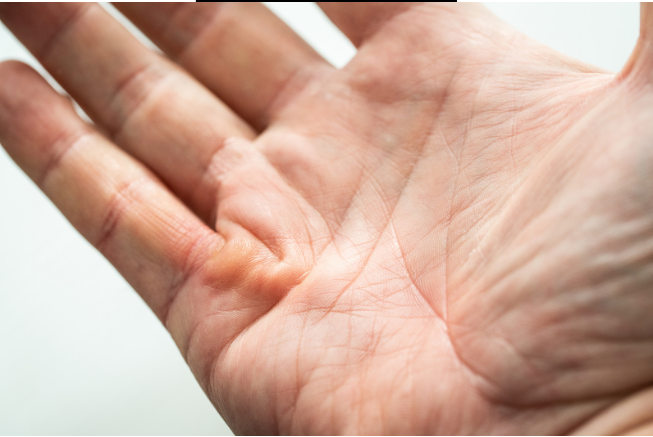
Dupuytren's disease starts beneath the skin of the palm.
Dupuytren’s disease is a non-cancerous condition that affects the palmar fascia, a layer of tissue beneath the skin of the hand. It may begin as one or more firm lumps, called nodules. Over time, the tissue can thicken into cords that pull a finger toward the palm.
The course is different for everyone. Some nodules remain unchanged for years. Others grow, form cords, or gradually limit how far a finger can straighten.
Understanding the Terms
Dupuytren’s Disease: The underlying condition.
Dupuytren’s Contracture: The later stage in which one or more fingers are fixed in a bent position.
Understanding Dupuytren’s Disease Progression

Nodule
A firm lump or thickened area in the palm.

CORD
A band of thickened tissue that can tighten over time.

CONTRACTURE
A finger that can no longer fully straighten because a cord is pulling it inward.

Radiation is generally discussed early—before a fixed contracture develops.
The goal of RT is not to release a cord. It is to treat active tissue at a stage when a radiation oncologist believes there may be an opportunity to slow or stabilize the process.
Steps Toward an RT Referral



When to Ask About RT
- A clinician has diagnosed Dupuytren’s nodules or cords in your palm.
- You or your care team have noticed change over time.
- Your fingers still have little or no fixed bending.
- You want to understand both non-invasive and procedural options before deciding what comes next.
RT Is Not a Fit for Everyone
Stable disease may only need observation. More advanced contracture usually calls for a hand-surgery assessment. Your age, health, disease pattern, previous treatment, and local clinical guidance also matter. Only a qualified clinician can determine whether RT is appropriate for you.
How RT Is Used in Early-stage Dupuytren's Disease
What RT May Do
- Treat active nodules and cords in a defined area.
- Help slow or stabilize progression in some people.
- Potentially delay the need for an invasive procedure.
What RT Does Not Do
- Cure Dupuytren’s disease.
- Remove a cord or straighten a fixed contracture.
- Guarantee that the disease will not progress or appear elsewhere in the hand.
What to Expect from Radiation Therapy
1. Consultation and Assessment
The team reviews your history, examines both hands, records nodules and cords,
measures finger movement, and looks for evidence of progression.
2. Planning and Positioning
The affected tissue is marked on the skin. Some clinics use CT imaging and a
repeatable hand position to plan the treatment area and dose.
3. Treatment Visits
Common published schedules include 10 treatments given as two five-day courses
separated by several weeks, or seven treatments given over about two weeks.
Your schedule may be different.
4. Skin Care and Follow-Up
Your team will explain how to care for the treated skin and how your hand will
be monitored after treatment.
How Adaptiiv Supports Delivery

A patient-specific bolus designed to the shape of your hand.
A bolus is a material placed on the skin during radiation therapy so the prescribed dose reaches tissue at or near the surface. The hand is a difficult area to fit: it is curved, irregular, and full of small spaces where a flat sheet can lift away from the skin.
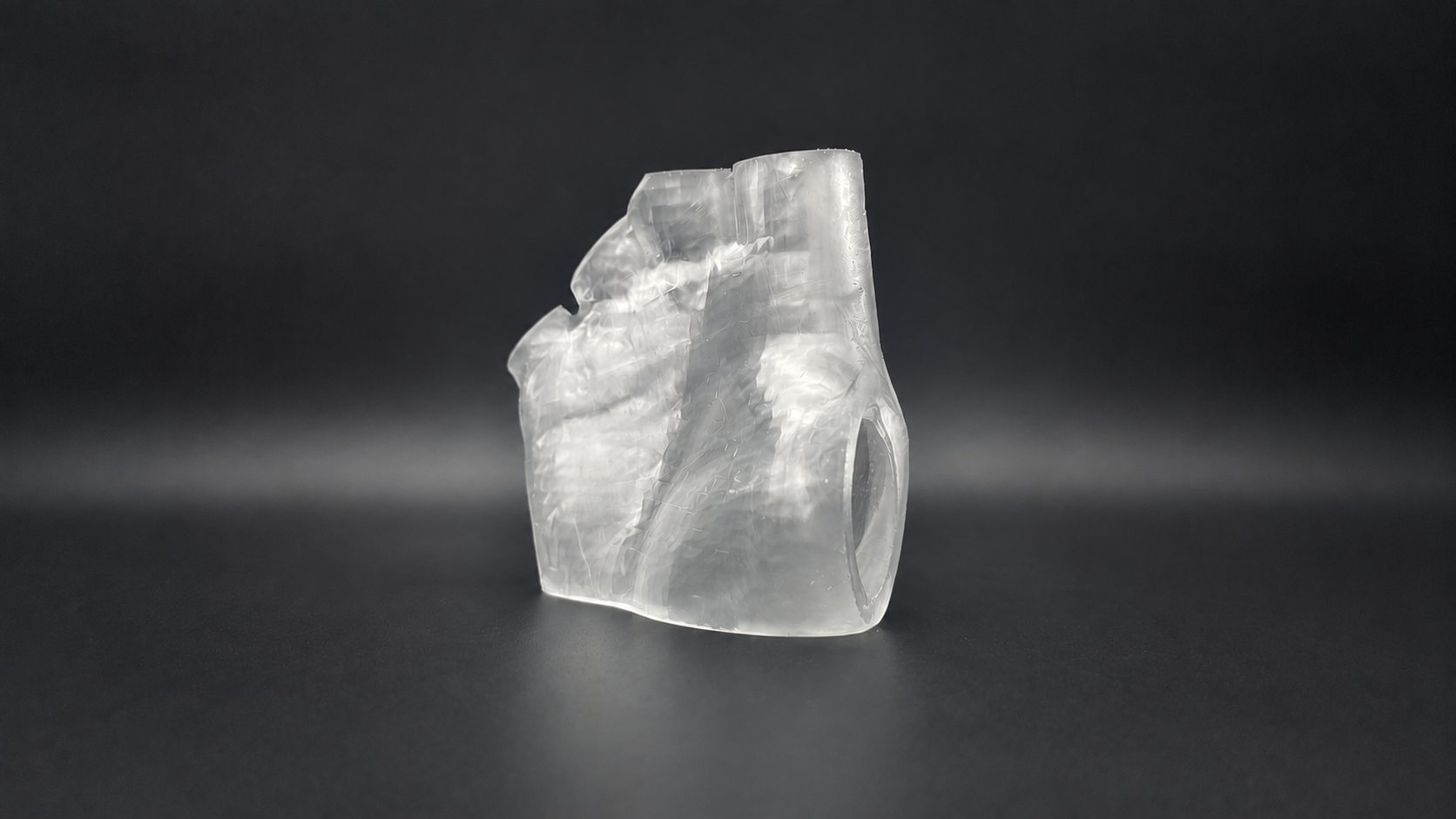
TrueFit – Clear Bolus is a rigid, transparent, patient-matched device designed from imaging data in Adaptiiv 3D Bolus software. It is made for one patient and can be used throughout that patient’s treatment course.

Designed to fit the anatomy
Patient-specific geometry is intended to improve contact and minimize air gaps around a complex surface.

Clear for visual alignment
The care team can see the hand, skin markings, and alignment points through the bolus during setup.
Shape-retaining for repeatable setup
The rigid design is intended to return to the planned position from one treatment visit to the next.
PUBLISHED CLINICAL EXPERIENCE
Adaptiiv Hosted Webinar on RT for Dupuytren's with Dr. Michael J. Yunes
In his 2025 Practical Radiation Oncology publication, Dr. Yunes describes a CT-based workflow for treating Dupuytren’s disease with RT at UMass Chan Medical School–Baystate. The approach uses Adaptiiv 3D Bolus software to create custom 3D-printed modulated bolus, supporting reproducible setup where conventional sheet bolus can be difficult to position consistently.
For additional clinical context, Dr. Yunes’ article in Practical Radiation Oncology is available here.

Questions to Ask Your Doctor
- Am I a good candidate for radiation therapy at this stage of my Dupuytren’s disease?
- How will you make sure the radiation dose is delivered accurately across the curves of my hand?
- What are the short and long-term side effects of radiation?
This page provides general educational information and is not medical advice. Adaptiiv does not diagnose Dupuytren’s disease, determine whether radiation therapy is appropriate, or select a treatment provider. Diagnosis and treatment decisions must be made by qualified healthcare professionals. Product indications and availability vary by country.